
TITLE OF THE INVENTION
Adaptive Biometric Audio Regulation System for Emotional Stability, Alertness, Cognitive Optimization, and Learning Enhancement
TECHNICAL FIELD
The present invention relates to adaptive audio systems that generate or modify music and spoken or sung content based on real-time physiological signals. More specifically, the invention concerns systems that employ multimodal biometric sensing, emotional and cognitive state interpretation, predictive modeling, and closed-loop audio modulation to influence human emotional dynamics, maintain wakefulness, enhance cognitive receptivity, and support learning.
BACKGROUND OF THE INVENTION
Human emotional states, cognitive performance, alertness, and learning capacity are tightly coupled to physiological processes governed by the autonomic nervous system, neurochemical signaling, and sensory integration. Music can influence these processes, but existing technologies do not adapt audio content dynamically based on real-time physiological feedback.
Conventional audio systems are static. While there are known systems for biometric-controlled music (such as U.S. Patent Nos. 9,235,198 and 9,449,084) that describe systems in vehicles and mobiles using biometric sensors to classify mood and recommend or select existing music, these technologies lack a closed-loop, predictive architecture that actively generates or modifies the audio structure. Similarly, technology for detecting driver fatigue (e.g., U.S. Patent Nos. 12,112,555 and U.S. Patent App. Pub. No. 2018/0244288) is known in the art, but relies on static alarms or warnings rather than active, real-time audio synthesis to regulate the user’s state.
Modern AI-based music generators lack the ability to continuously measure biometric signals, interpret complex states, learn individual physiological response patterns, predict future reactions, or actively synthesize music in real-time to achieve targeted emotional outcomes. Furthermore, no existing technology integrates multimodal biometric sensing into a unified adaptive audio engine capable of executing cognitive pattern interruptions or managing physiological habituation. There is therefore a need for a system that overcomes these limitations.
SUMMARY OF THE INVENTION
The invention provides a system for real-time generation and modulation of music and audio content based on multimodal biometric signals. The system comprises a biometric sensing subsystem, a signal processing module, an emotional and cognitive state classification module, a personalized response model, a predictive engine, an adaptive AI audio engine (107), and a closed-loop feedback controller.
The biometric subsystem measures physiological parameters such as heart rate variability, galvanic skin response, respiration, pupillary dynamics, eye movements, EEG activity, thermal patterns, and sweat chemistry. These signals are processed to extract features that reflect the user’s emotional and cognitive state. The personalized response model stores historical biometric reactions to specific audio parameters, constructing an individualized emotional and cognitive dynamics profile.
The adaptive AI audio engine (107) generates new music or modifies existing tracks based on predicted and real-time biometric feedback. The closed-loop feedback controller continuously compares the user’s biometric state with a target state and dynamically adjusts audio parameters until the desired emotional or cognitive condition is achieved. The system features advanced regulatory mechanisms, including anti-habituation monitoring to transition audio profiles when physiological responses diminish, and algorithmic cognitive pattern interruption to break severe negative psychological loops.
Additionally, the system includes an alertness module that detects drowsiness and increases auditory stimulation to maintain wakefulness, and a learning enhancement module that integrates spoken or sung instructional content and optimizes cognitive receptivity.
BRIEF DESCRIPTION OF THE DRAWINGS
The invention will now be described with reference to the accompanying drawings, which illustrate exemplary embodiments of the system. Identical reference numerals denote identical or functionally equivalent elements throughout the figures.
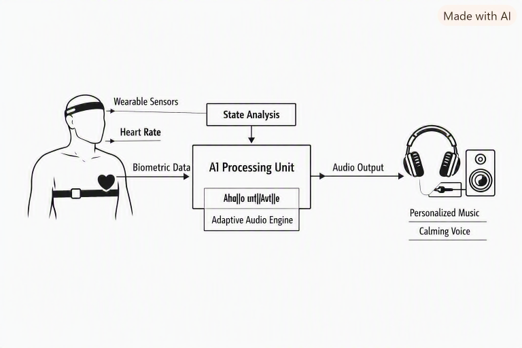
- FIG. 1 illustrates the overall architecture of the adaptive audio regulation system, showing the data flow from biometric sensors (101) through the classification module (105) to the adaptive AI audio engine (107).
- FIG. 2 illustrates the multimodal biometric sensing subsystem (101), detailing wearable and hardware-agnostic sensor configurations including head-mounted devices (201), thoracic sensors (202), and chemical/thermal sensors (203).
- FIG. 3 illustrates the personalized response model (106), detailing the time-series database (301), the temporal decay algorithm (302), and the habituation monitoring module (303).
- FIG. 4 illustrates the adaptive AI audio engine (107), including the generative module (401), the transformative module (402), and the cognitive pattern interruption trigger (403).
- FIG. 5 illustrates the closed-loop feedback controller (108) and the real-time audio output regulation process.
- FIG. 6 is a flowchart illustrating the closed-loop method for adaptive biometric audio regulation, detailing the operational steps from initial biometric measurement to target state verification.
DETAILED DESCRIPTION OF THE INVENTION
System Architecture Overview: FIG. 1 illustrates the overall architecture of the adaptive audio regulation system (100). The system operates as a continuous, closed-loop architecture designed to regulate a user’s emotional and cognitive state through real-time audio generation. Biometric sensors (101) and optional user input mechanisms (102) communicate through a data interface (103) to a signal processing module (104).
The processed signals are interpreted by an emotional and cognitive classification module (105), which feeds into a personalized response model (106). This model directs an adaptive AI audio engine (107), whose output is continuously evaluated by a closed-loop feedback controller (108) before being delivered to the user through an audio output device (109). The predictive engine forecasts future biometric responses based on the personalized response model and provides anticipatory control signals to the adaptive AI audio engine (107), enabling preemptive modulation of audio parameters before undesirable emotional or cognitive states fully manifest.
Flexible Biometric Data Collection: Referring to FIG. 2, the biometric sensing subsystem (101) is designed to be hardware-agnostic and operates independently of fixed environmental cameras. It gathers data via non-invasive wearable sensors.
- A head-mounted device (201), such as smart glasses, integrates sensors to capture pupillometry, eye tracking, EEG activity, and facial micro-expressions.
- A thoracic sensor (202), such as a chest-worn Inertial Measurement Unit (IMU), continuously monitors respiration metrics, including intake volume and frequency, to detect rapid indications of stress or panic.
- Wearable biometric bands, such as wrist-worn devices or smartwatches, may be integrated to monitor cardiovascular metrics like heart rate variability and electrodermal activity via optical and dermal sensors.
- Implantable and minimally invasive sensors, including subdermal chips for high-precision biochemical monitoring, and neural interfaces or Brain-Computer Interfaces (BCIs). Such neural interfaces may be configured to directly monitor high-resolution intracranial electrophysiological activity, bypassing external artifacts to provide direct cognitive and emotional state data.
- Chemical and thermal sensors (203) analyze sweat composition and skin temperature variations as metrics for autonomic arousal.
Integration of Known Biometric Sensing Technologies: To ensure robust and accurate physiological data collection, it is to be understood that the underlying hardware and basic signal transduction methodologies for sensing these parameters are known in the art; the present invention focuses on the novel integration, processing, and closed-loop application of this multimodal data.
- Cardiovascular and HRV Monitoring using PPG sensors.
- Electrodermal Activity (EDA/GSR) using dermal electrodes.
- Respiration tracking using IMUs or impedance pneumography.
- EEG monitoring using dry-electrode wearable systems.
- Sweat chemistry and skin temperature monitoring using microfluidic and infrared sensors.
Audio Generation and Synthesis Methodologies: The adaptive AI audio engine utilizes established digital audio synthesis technologies, including frequency modulation and wavetable synthesis, dynamically modified via biometric feedback. Real-time generative machine learning frameworks create personalized musical structures, while neural network-based text-to-speech (TTS) systems generate spoken instructional content.
Data Processing and the Historical Database: As shown in FIG. 3, the personalized response model (106) utilizes a synchronized time-series database (301) to manage historical data. The signal processing module (104) maps biometric feature vectors against audio parameter vectors to establish a quantitative baseline of cause and effect. A temporal decay algorithm (302) weights recent physiological reactions more heavily than older baselines. A habituation monitoring module (303) tracks the rate of physiological change. If the user’s physiological response diminishes, the database assigns a degraded efficacy score to the active audio profile, prompting a transition to an alternative audio strategy.
Audio Generation and Cognitive Pattern Interruption: Referring to FIG. 4, the adaptive AI audio engine (107) dynamically synthesizes or modifies audio content using a generative module (401) and a transformative module (402). The system features a cognitive pattern interruption trigger (403) configured to detect physiological signatures indicative of negative cognitive loops or escalating emotional distress. Such signatures may include sudden spikes in respiration rate or characteristic EEG beta-band activity, which the emotional and cognitive state classification module (105) interprets as markers requiring immediate intervention. Upon detection of these signatures, the generative module (401) produces a temporary, algorithmically improvised, and historically unfamiliar acoustic perturbation designed to disrupt the ongoing cognitive pattern.
Once biometric feedback indicates a momentary cognitive reset, the system transitions to a historically validated comforting audio profile previously correlated with stable biometric patterns. In certain embodiments, the adaptive AI audio engine (107) may generate spoken calming messages or interest based verbal content using neural network-based text-to-speech systems. Such spoken content may be selected or synthesized to momentarily redirect the user’s cognitive focus and support interruption of negative cognitive loops, particularly in scenarios involving phobia, anxiety, or situational distress.
Closed-Loop Feedback and Specific Embodiments: FIG. 5 illustrates the closed-loop feedback controller (108) continuously comparing the user’s real-time biometric state with a target state. The closed-loop feedback controller (108) detects statistically significant deviations from predefined biometric thresholds. The predefined biometric thresholds may be computed dynamically based on statistical deviations from the user’s historical baseline, such as exceeding a moving average, variance band, or z-score derived from the time-series database (301). Such deviations automatically trigger the adaptive AI audio engine (107) to generate or modify audio content using generative machine learning frameworks.
The system dynamically assists the user across various psychological scenarios:
- Phobia and Anxiety Alleviation: Audio parameters synchronize with and gradually slow respiration to induce parasympathetic recovery.
- Psychological Support: Personalized audio profiles are deployed and shifted based on habituation monitoring.
- Cognitive Optimization and Learning: Spoken or sung instructional content is dynamically modulated to maintain cognitive receptivity.
- Alertness Management: Drowsiness indicators trigger increased auditory stimulation to maintain wakefulness.
User Interaction and System Initialization: In at least one embodiment, the system (100) includes a user interaction interface configured to allow the user to initiate, configure, and terminate operation of the adaptive audio regulation process. The interface may be implemented in a mobile application, a wearable device, or any computing platform capable of communicating with the biometric sensing subsystem (101) and the adaptive AI audio engine (107). To begin operation, the user may activate the system through a simple start command, such as pressing a physical button on a wearable device or selecting a start control within a software interface.
Upon activation, the system initializes biometric data acquisition and loads a default audio profile or a user-selected preferred audio category. In certain embodiments, the user may select one or more preferred audio types such as specific musical genres, calming soundscapes, or instructional content through a configuration menu. These preferences are stored in association with the personalized response model (106) and may be used as initial audio parameters before closed-loop regulation begins.
During operation, the user may optionally provide manual input, such as selecting alternative audio profiles, adjusting intensity levels, or indicating a desired target state (e.g., relaxation, alertness, or learning mode). Such inputs are processed by the signal processing module (104) and integrated into the closed-loop feedback controller (108) without interrupting real-time biometric regulation. To terminate operation, the user may issue a stop command through the same interface. Upon receiving the stop command, the system ceases biometric data acquisition, gradually attenuates audio output to avoid abrupt transitions, and stores the final biometric and audio parameter vectors in the time-series database (301) for future personalization.
Method of Operation: Referring to FIG. 6, the operation of the system (100) is illustrated as a continuous algorithmic method. The process initializes by measuring at least one physiological parameter (610) via the biometric sensing subsystem (101). These signals are processed (620) by the signal processing module (104) and subsequently used to classify the user’s emotional and cognitive state (630) via the classification module (105). The system then predicts a future biometric response (640) based on the personalized response model (106). Based on this prediction, the adaptive AI audio engine (107) generates or modifies audio content (650), which is output to the user (660). A continuous decision loop (670) is executed by the closed-loop feedback controller (108) to evaluate if the target biometric state is achieved; if the target state is not met, the audio parameters are continuously adjusted until physiological stabilization is confirmed.
General Statement of Non-Limitation: It is to be understood that the invention is not limited to the specific embodiments described herein, and that variations in sensor modalities, signal processing techniques, audio generation methods, and feedback control strategies may be implemented without departing from the scope of the invention as defined by the claims.
Internal Links
- Detailed overview of the FrykenDiamond™ innovation
- FrykenDiamond™ – Create your eternal memory among the stars
- FrykenDiamond™ – Mechanical Lunar Surface Stabilization Using a Lightweight Roller
- The Future of Winter Sports: FrykenFrost™ – Race-Ready Snow Guaranteed
- FrykenFrost™ – Surface Cooling System
- Sitemap / Link Page.